
Explore Our Products
Food Grade
Original price was: ₹4,999.00.₹3,499.00Current price is: ₹3,499.00.
Food Grade
Original price was: ₹5,999.00.₹3,999.00Current price is: ₹3,999.00.

Food Grade
Original price was: ₹2,799.00.₹1,899.00Current price is: ₹1,899.00.
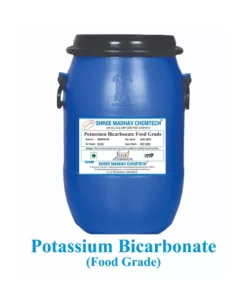
Food Grade
Original price was: ₹2,999.00.₹1,999.00Current price is: ₹1,999.00.
CONTACT US


WhatsApp Support
Get quick support on WhatsApp.


Download Brochure
Download complete product and service details.
Potassium Bicarbonate
Potassium Bicarbonate (KHCO₃) is a versatile inorganic compound used in food processing, agriculture, manufacturing, water treatment formulations and other commercial applications. Also known as Potassium Hydrogen Carbonate, it is valued for its water solubility, mild alkaline properties and useful bicarbonate chemistry.
Different applications require different grades and specifications. A food manufacturer may focus on food-grade quality and documentation, while an industrial buyer may need particular technical properties for a manufacturing process.
This page provides clear information about Potassium Bicarbonate, including its properties, common uses, food and agricultural applications, differences from similar compounds, quality considerations, safe handling and commercial requirements.
The right product should always be selected according to its intended application, required grade and relevant technical or regulatory requirements.
Explore Potassium Bicarbonate Products
Choose Potassium Bicarbonate according to your application and required quantity. Product options are available for suitable food, commercial and other approved applications.
Before using the material in a regulated or technical process, confirm the applicable grade, specification and supporting product documentation.
What Is Potassium Bicarbonate?
Potassium Bicarbonate is an inorganic potassium compound with the chemical formula KHCO₃. It is also commonly known as Potassium Hydrogen Carbonate or Potassium Hydrogencarbonate.
The compound contains potassium and bicarbonate ions. Under normal conditions, it is generally found as a white crystalline powder or solid and is soluble in water.
When dissolved, it produces a mildly alkaline solution.
Its bicarbonate chemistry allows the compound to react with suitable acids. Carbon dioxide can be released during these reactions, which is one reason bicarbonates are useful in certain food and manufacturing processes.
Potassium content is another important characteristic.
Potassium is an essential mineral and plant nutrient. The combination of potassium and bicarbonate chemistry allows KHCO₃ to serve different functions depending on how it is used.
Its role should therefore be evaluated according to the complete application rather than from the chemical name alone.
Properties and Key Information
Potassium Bicarbonate has several physical and chemical characteristics that help explain its commercial value.
-
Chemical Name: Potassium Bicarbonate
-
Alternative Name: Potassium Hydrogen Carbonate
-
Chemical Formula: KHCO₃
-
CAS Number: 298-14-6
-
Molecular Weight: approximately 100.12 g/mol
-
Appearance: generally white crystalline material
-
Solubility: soluble in water
-
Chemical Character: mildly alkaline
-
Main Components: potassium and bicarbonate ions
-
Application Areas: food processing, agriculture, manufacturing, pH management and technical processes
These are general characteristics of the compound and should not be considered the complete specification of every commercially available product.
Purity, moisture, particle characteristics and other specifications may vary according to grade and manufacturer.
For commercial use, buyers should review the technical information for the exact product being supplied.
How Potassium Bicarbonate Works
The usefulness of KHCO₃ comes largely from its bicarbonate chemistry and potassium content.
When bicarbonate comes into contact with a suitable acidic substance, an acid-base reaction can occur. Carbon dioxide may be released during this reaction.
This property can be useful in applications involving leavening, acid neutralisation or controlled formulation.
The compound also provides potassium ions when dissolved in water.
Heat can change its chemical form. When exposed to sufficient heat, Potassium Bicarbonate can decompose to form potassium carbonate while releasing carbon dioxide and water.
Actual performance depends on the environment in which the compound is being used.
Temperature, concentration, moisture, acidity, other ingredients and processing conditions can all influence the final result.
Professional users should therefore evaluate the complete formulation or process before determining how the material should be used.
Common Uses of Potassium Bicarbonate
The combination of mild alkalinity, water solubility, potassium content and bicarbonate chemistry makes Potassium Bicarbonate useful across several industries.
In food processing, it can have a role in suitable leavening, acidity-control and formulation systems.
Agricultural applications may use its potassium content or incorporate the compound into particular crop-management products.
Manufacturing and technical processes may use it where controlled alkalinity, buffering or other bicarbonate properties are required.
Certain specialized fire-suppression formulations have also used Potassium Bicarbonate as an active component.
The function changes according to the application.
This is why a buyer should first understand the intended use and then choose an appropriate grade rather than assuming that every Potassium Bicarbonate product is interchangeable.
Food Applications
Food-grade Potassium Bicarbonate can be used in suitable food and beverage applications where relevant regulations and formulation requirements allow its use.
Its bicarbonate properties can make it useful in certain leavening, acidity-control, buffering and pH-management applications.
An important difference between this compound and sodium bicarbonate is the mineral ion.
Potassium Bicarbonate contains potassium, while sodium bicarbonate contains sodium.
This can make a potassium-based bicarbonate relevant to manufacturers developing formulations with particular ingredient or nutritional objectives.
However, the two ingredients should not automatically be exchanged in equal quantities.
Differences in molecular weight and chemical characteristics can influence reaction balance, taste, pH, texture and overall product performance.
Commercial manufacturers should conduct appropriate calculations and formulation trials before making significant ingredient changes.
The product grade is equally important.
Material intended only for general industrial use should not automatically be assumed to meet food requirements.
Businesses using KHCO₃ in food production should confirm that the selected product is suitable for their intended application and review the applicable specification and supporting documentation.
For more detailed information about this application, visit our Food Grade Potassium Bicarbonate page.
Use in Bakery and Leavening Systems
Bicarbonate compounds are commonly associated with formulations where controlled carbon dioxide generation is required.
Potassium Bicarbonate can participate in this process when suitable acidic ingredients are present.
The reaction can release carbon dioxide, which may contribute to the structure of a properly developed bakery or food product.
Performance depends on the complete formulation.
Acid type, ingredient quantity, moisture, temperature, mixing method and processing time can all influence the reaction.
There is therefore no single quantity that should be assumed to work for every recipe.
Commercial bakeries and food manufacturers should determine suitable quantities through formulation development and controlled product trials.
pH and Acidity Management
Managing acidity is important in many food, beverage and manufacturing processes.
Because Potassium Bicarbonate has mildly alkaline characteristics, it may be useful in suitable systems where controlled acidity or pH adjustment is required.
When introduced into an acidic formulation, bicarbonate chemistry can influence the acid-base balance.
The final result depends on more than the amount of KHCO₃ added.
Existing acidity, buffering capacity, temperature, concentration and other ingredients can all influence pH.
Accurate measurement is therefore important.
Commercial users should establish appropriate quantities through controlled testing rather than copying a dosage developed for a different product or process.
Mineral and Drinking-Water Applications
Potassium Bicarbonate may also be considered in suitable water-processing applications after the required purification process has been completed.
In controlled remineralisation systems, bicarbonate ingredients may contribute to alkalinity and mineral balance.
However, Potassium Bicarbonate is not a water-purification treatment by itself.
It does not replace filtration, reverse osmosis, UV treatment, ozone treatment, disinfection or other processes required to produce safe drinking water.
Its role should be considered separately from purification.
The correct quantity cannot be determined from a universal online formula because treated water can differ significantly between facilities.
Existing pH, alkalinity, TDS, mineral composition and the required finished-water specification should be evaluated before regular dosing is established.
Water analysis and controlled trial batches can help manufacturers determine an appropriate formulation.
Agricultural Applications
Potassium Bicarbonate also has established uses in agriculture.
Potassium is an essential nutrient involved in normal plant development and several important physiological processes.
The compound is also used as an active ingredient in certain agricultural formulations developed for specific crop-management purposes, including the management of some fungal plant diseases.
Agricultural performance depends on several factors.
Crop type, growth stage, environmental conditions, application timing, concentration, disease pressure and the complete formulation may all influence results.
For this reason, general information about the raw chemical should not replace the directions supplied with an approved agricultural product.
Growers and commercial agricultural users should follow applicable product labels, local regulations and professional crop-management guidance.
Potassium is important for plants, but adding more potassium does not automatically produce better growth.
Existing soil conditions and nutrient levels should be considered when making crop-nutrition decisions.
Industrial Applications
Potassium Hydrogen Carbonate is also used in selected industrial and manufacturing processes.
Its water solubility, potassium content and bicarbonate chemistry can make it useful where controlled alkalinity, buffering or other specific chemical behavior is required.
Industrial requirements can vary significantly.
One manufacturer may require a particular purity level. Another may focus on particle characteristics, moisture limits or compatibility with other ingredients.
A material suitable for one process may not automatically be suitable for another.
Industrial buyers should therefore evaluate the technical specification of the actual product rather than selecting a raw material only because its chemical name matches their requirement.
Small-scale process testing may also be useful before introducing a new raw material into regular commercial production.
Use in Fire-Suppression Formulations
Potassium Bicarbonate has also been used in certain specialized dry chemical fire-suppression formulations.
Its chemical behavior under fire conditions can make it useful as an ingredient in properly designed extinguishing systems.
However, ordinary Potassium Bicarbonate powder should not be treated as a replacement for approved fire-extinguishing equipment.
Commercial fire-suppression products are complete engineered systems.
Particle characteristics, formulation, delivery equipment, testing and certification can all influence performance.
Fire protection should rely on equipment approved and suitable for the relevant type of fire hazard.
Potassium Bicarbonate vs Sodium Bicarbonate
Potassium Bicarbonate and sodium bicarbonate belong to the same general bicarbonate family, but they are different chemical compounds.
Potassium Bicarbonate has the formula KHCO₃.
Sodium bicarbonate has the formula NaHCO₃.
The main difference is that one contains potassium while the other contains sodium.
This distinction can be important in food processing and other formulations.
A manufacturer interested in using a potassium-based ingredient may consider KHCO₃, but the change should be evaluated technically.
The compounds have different molecular weights, and substitution can affect formulation balance, taste, pH and processing behavior.
A direct one-to-one replacement should therefore not be assumed.
Neither ingredient is universally better than the other.
The correct choice depends on the purpose of the formulation and the characteristics required from the finished product.
Potassium Bicarbonate vs Potassium Carbonate
Potassium Bicarbonate and potassium carbonate also have similar names but should not be confused.
Potassium Bicarbonate has the formula KHCO₃, while potassium carbonate has the formula K₂CO₃.
Their chemical properties are different.
Potassium carbonate generally produces a more strongly alkaline solution than Potassium Bicarbonate.
This difference can significantly influence formulations where pH and alkalinity need careful control.
The compounds are chemically related.
When Potassium Bicarbonate is heated sufficiently, it can decompose and form potassium carbonate while releasing carbon dioxide and water.
Businesses should confirm the exact chemical name, formula and specification when purchasing either material.
Understanding Grades and Specifications
Commercial Potassium Bicarbonate may be available in different grades depending on the manufacturer and intended application.
The correct grade should be chosen according to how the material will be used.
Food production may require specifications and documentation that differ from general industrial manufacturing.
Agricultural applications may involve specially formulated or approved products.
Technical manufacturing can have its own requirements for purity and physical characteristics.
This is why purchasing should begin with the application.
Once the intended use is clear, buyers can determine which grade, specification and documentation they need.
Choosing only according to price or chemical name can increase the risk of receiving a material that does not match the process.
Purity, Quality and Consistency
Purity is an important factor when evaluating a chemical raw material, but it is not always the only quality consideration.
Different applications may require different technical characteristics.
Physical properties, moisture, consistency, traceability and other specifications may matter depending on the process.
Commercial manufacturers should define the characteristics that are important to their finished product.
Batch consistency is particularly valuable for businesses using the material regularly.
Unexpected changes in raw-material characteristics can affect manufacturing performance or finished-product quality.
A defined incoming-material approval process can help businesses maintain better control over regular production.
Product Documentation
Technical documentation is an important part of professional chemical purchasing.
A product specification can provide information about the characteristics of a particular grade.
A Certificate of Analysis may provide relevant information for an applicable batch.
A Safety Data Sheet provides important guidance about handling, storage, exposure controls, first-aid measures and other safety considerations.
Documentation requirements can vary according to application.
A food manufacturer may have different requirements from an industrial buyer.
Customers purchasing material for regulated applications should communicate their documentation requirements before confirming an order.
Documents should always relate to the actual product, manufacturer or batch where applicable.
General website information should not be used as a substitute for product-specific technical documents.
Quality and Regulatory Information
When Potassium Bicarbonate is purchased for a regulated application, relevant quality and regulatory requirements should be confirmed before use.
Any certification, approval or compliance claim should match the valid documentation applicable to the specific product, manufacturer, batch or licence coverage.
Buyers should not assume that a general statement automatically applies to every available product.
For commercial production, review the relevant product specification and supporting documents before approving the material.
This is particularly important for food, beverage, drinking-water and other regulated applications.
Clear documentation creates greater transparency between supplier and buyer and helps reduce misunderstandings about product suitability.
Safe Handling
Good chemical-handling practices should be followed when working with Potassium Bicarbonate.
The appropriate precautions depend on the quantity, physical form, workplace and process.
Unnecessary dust generation should be avoided during transfer and handling.
Suitable workplace ventilation and good hygiene practices can help maintain cleaner working conditions.
Personal protective equipment should be selected according to the actual workplace risk assessment and the Safety Data Sheet supplied for the product.
Industrial operations may require controls that are different from those needed for handling small quantities.
For this reason, workplace procedures should be based on the actual operation rather than general assumptions.
Storage
Proper storage helps protect the quality of Potassium Bicarbonate.
The material should generally be kept in a clean and dry environment and protected from unnecessary moisture and contamination.
Containers should remain properly closed when the product is not being used.
The exact storage requirements can depend on the product and grade.
Materials intended for food or other regulated applications should be handled according to suitable hygiene and contamination-control procedures.
Businesses should follow the storage recommendations provided with the actual product.
Good inventory control and traceability can also help maintain consistent raw-material management.
Choosing the Right Potassium Bicarbonate
The best product is the one that matches the requirements of the application.
Begin by identifying how the material will be used.
Then determine the required grade, technical specifications, quantity and documentation.
A food processor may need a different product from an industrial manufacturer. A business conducting formulation trials may also have different purchasing needs from a large manufacturer requiring regular bulk supply.
Price should therefore be considered together with quality and suitability.
Selecting the lowest-cost material without reviewing its specifications can create larger costs if it causes manufacturing or compliance problems later.
Clear technical requirements make product comparison easier and help buyers make more informed purchasing decisions.
Buying Potassium Bicarbonate in India
Customers looking to purchase Potassium Bicarbonate should first determine their required quantity and intended application.
Small quantities may be useful for product trials, laboratory evaluation or businesses with limited regular consumption.
Larger commercial quantities may be required by established manufacturers, food processors, water plants, wholesalers or industrial users.
Before placing a significant commercial order, buyers should confirm the selected product grade and any technical documentation required for their application.
Delivery arrangements can depend on order quantity, destination and product availability.
For detailed purchasing information, commercial requirements and current product options, visit our Buy Potassium Bicarbonate page.
Commercial and Bulk Requirements
Businesses purchasing larger quantities should provide clear information about their requirements when requesting a quotation.
The intended application, required grade, quantity, delivery destination and documentation requirements can help determine whether the available product is suitable.
Regular commercial users may also need consistency between repeat orders.
Discussing these requirements before purchasing can help reduce misunderstandings and make the supply process more efficient.
If your application requires a particular specification, confirm it before completing the order rather than assuming that every grade has identical characteristics.
Why Clear Product Information Matters
Chemical purchasing decisions should be based on useful information rather than exaggerated marketing claims.
Potassium Bicarbonate has many established applications, but that does not mean every grade is suitable for every use.
A professional approach begins by understanding the application.
Technical specifications should then be evaluated against the requirements of the process.
For regulated uses, relevant documentation should also be checked.
This approach helps businesses choose materials more responsibly and creates realistic expectations about product performance.
Frequently Asked Questions
What is Potassium Bicarbonate?
Potassium Bicarbonate is an inorganic potassium compound with the chemical formula KHCO₃. It is also known as Potassium Hydrogen Carbonate and is generally available as a white crystalline material.
What is Potassium Bicarbonate used for?
It is used in suitable food-processing, agricultural, manufacturing, pH-management and other technical applications. The exact use depends on the product grade and formulation.
What is the chemical formula of Potassium Bicarbonate?
The chemical formula is KHCO₃.
What is the CAS number?
The CAS number commonly used to identify Potassium Bicarbonate is 298-14-6.
Is Potassium Bicarbonate soluble in water?
Yes. Potassium Bicarbonate is soluble in water.
Is Potassium Bicarbonate the same as baking soda?
No. Baking soda commonly refers to sodium bicarbonate, which has the chemical formula NaHCO₃. Potassium Bicarbonate has the formula KHCO₃ and contains potassium instead of sodium.
Can Potassium Bicarbonate be used in food processing?
A suitable food-grade product may be used in permitted food-processing applications where relevant formulation and regulatory requirements are met. The exact product grade and documentation should be verified before commercial use.
Can Potassium Bicarbonate be used in mineral water?
It may be used in suitable controlled remineralisation or formulation processes after the necessary water purification has been completed. The appropriate quantity depends on the water chemistry and required finished-water specification.
Does Potassium Bicarbonate purify water?
No. It should not be considered a replacement for filtration, RO, UV, ozone treatment, disinfection or other required purification processes.
Is Potassium Bicarbonate used in agriculture?
Yes. It has agricultural applications and is also found in certain products intended for specific crop-management purposes. The approved directions for the actual agricultural product should be followed.
Is Potassium Bicarbonate the same as potassium carbonate?
No. Potassium Bicarbonate is KHCO₃, while potassium carbonate is K₂CO₃. Their alkalinity and chemical behavior are different.
How should Potassium Bicarbonate be stored?
It should generally be kept in suitable closed containers in a clean and dry environment and protected from moisture and contamination. Product-specific storage instructions should always be followed.
How do I choose the correct grade?
Start with your intended application. Then determine the required quality, technical specification and documentation. Requirements for food, agricultural and industrial applications can be different.
For additional answers about product applications, ordering and documentation, visit our Potassium Bicarbonate FAQ page.
Looking for Potassium Bicarbonate?
Choosing the right Potassium Bicarbonate begins with understanding your requirement.
Whether you need material for food processing, manufacturing, water formulation, product trials or another suitable commercial application, confirm the grade and technical specification before ordering.
For commercial enquiries, provide your required quantity, intended application, delivery location and any documentation requirements.
This information makes it easier to evaluate the requirement accurately and identify an appropriate product.
Our aim is simple: provide clear product information, support informed purchasing decisions and help customers choose Potassium Bicarbonate according to their actual application.
Contact us for product availability, technical documents, commercial enquiries or bulk requirements.